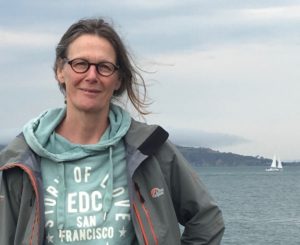
 I have known Mina ever since I started writing in 2011 and joined SCBWI France/International. We have met up at several conferences and last summer I got to see her in her incredible writing environment at her Berkeley home. I have spent many hours brainstorming writing projects and challenges with her and always value her advice.
[JM] Where are you from and how has that influenced your writing career?
[MW] I am from the Netherlands, more specifically, from a tiny town in the south, in the province of Brabant. There was ample space for adventure, for exploration, for roaming free in my hometown. The desire for adventure, for exploration and for roaming free instilled in me in those early years, has never left me and is the beating heart of all my stories. Let me give you an example: Just around the corner from where I lived was a military base with fields and an assault course; the ideal playground for fearlessly curious kids like us. We would cut gaps in the high, barbed-wired fence that enclosed the obstacle course, sneak in and race each other, until troops would emerge from the barracks to chase us away, or worse, to nab us and hand us over to the base commander, a man we called Donderbaas, Thunder Boss. Luckily, we were well-trained and super fast, and mostly we’d outrun the troops. My debut middle grade novel De wraak van Deedee, Deedee’s Revenge, starts out at that assault course, when Deedee’s brother Matthias dares her to race him and his friend Peter. The book’s main theme is sibling rivalry solidly wrapped in adventure.
[JM] Please tell us a little about your work-in-progress! Pretend we’re in an elevator and instead of us all looking around nervously, you tell us all about what you are writing! Go!
[MW] My work-in-progress is the story of a young girl on a quest to find redemption and equanimity after she sells out her gender-fluid sibling. Kicked out by her father as well as her sibling, for diabolically opposed reasons, she finds herself on the streets. When she accepts a ride from a traveling tattoo artist, she embarks on a cathartic road trip to find the courage to face her demons and begin to grasp the true meaning of normal, of bias, of self-determination, of what it entails to be an ally.
[JM] How did you get into writing? Is it something you’ve always been into?
[MW] My mother was a raconteur—“poetic license” should have been her middle name—and I inherited her knack for storytelling. My father was an architect and he imprinted me with a passion for math and science. And indeed, my first writings were the specs with his designs, even before I could read and write. The start of my real writing career, though, I attribute to high school. One of my greatest joys in high school was detention for the sole reason that detention meant writing essays. When, after an avalanche of essays, the principal realized his punitive regime had a reverse effect, he ordered me to write the essays in German, in French and, ultimately, in English. It only deepened my fondness of literature and language (although I never let go of my love for math and science, either!) After high school, I got caught up in life’s turbulence and only after my son’s birth, did I rediscover my love for writing.
[JM] What and/or who inspired your fabulous Boreas series? These are exactly the sort of adventure stories I adored as a tween.
[MW] My father taught us to sail even before we could ride a bicycle (which is extraordinary for Dutch people, who are basically born with a bicycle attached to them). Later in life, after my siblings and I had all left home, my parents sold everything they had, bought a bigger boat and set sail, until my mother, much too young, died of cancer. Every year, I would find time to sail with them for a month or so. During the twelve years that they roamed the seven seas, my mother kept a logbook and after her death I inherited those. Boreas is based on my own sailing and traveling adventures and on her logbooks.
[JM] If you like [fill in the blank], you’ll like BOREAS….?
[MW] If you like riveting action and adventure, but also don’t want to shut your eyes for the problems of the world, like refugees and plastic soup, you’ll like BOREAS…
How the series starts?
Boreas—Bo or Boaty to his friends—is all set to go to junior high after summer break when his life comes tumbling down after his parents break the news that the family is going on a trip around the world on their sailboat. Reluctant and peeved at being left out of the decision, Boreas boards the Argo, the ship that will be their home for the next years.
The first few days he is bored and misses his friends. Then, in the dead of night, the Argo crashes into what seems a pile of ocean debris, were it not that someone shouts for help. Without a second thought, Boreas dives into the icy-cold water to rescue a drowning teenager, a refugee who tried to cross the English Channel on a self-built raft. Boreas desperately wants to help him and they anchor near the French coast to find a solution. But there seems no way to circumvent laws and the next morning the refugee has fled the Argo. Boreas realizes that freedom is not a given for everyone and how privileged he is.
This is only the first of many of Boreas’s adventures that range from tractor racing to being caught on a fishing vessel as a stowaway. I have tried to bring the journey around the world realistically: not just the romantic dream, but also the loneliness, the dangers, the unpredictability. A Dutch reviewer said: “It doesn’t matter if like sailing or traveling, if you are a boy or a girl, a man or a woman: no one will regret choosing this book.”
[JM] I know you are a sought-after writing craft teacher. Without giving away too much, as I would love some of my readers to attend your workshops, could you give us a taste of how you explore plot & story structure as a revision technique?
[MW] Ah, one of my favorite topics! Here is where my math brain and story brain coalesce. I explore plot and story structure in a very visual way and for this particular workshop I have combined two of my favorite plot structures. We usually have one or more of these structures in the back of our minds and we can dream the most important plot points. We’ve listened to countless explanations. But to me it is always most illuminating when I can apply what I hear to my own writings. It’s why I ask my attendees to bring a paper copy of their manuscript or, if they work in Scrivener—Did I say that I love Scrivener? I do!—bring their laptop. It can be a first draft or a tenth draft and even a partial where you got stuck.
After a brief introduction of both structures and some well-known examples to illustrate, I guide attendees through their manuscripts, tagging and color-coding plot points. What’s important in this class is that it is not a linear process and that every plot point comes with a set of questions that will reveal not only plot holes and gaps in your story, but also problems with pacing and placing. The end result is a color-coded visual of your story that gives a lot of insight and food for revision.
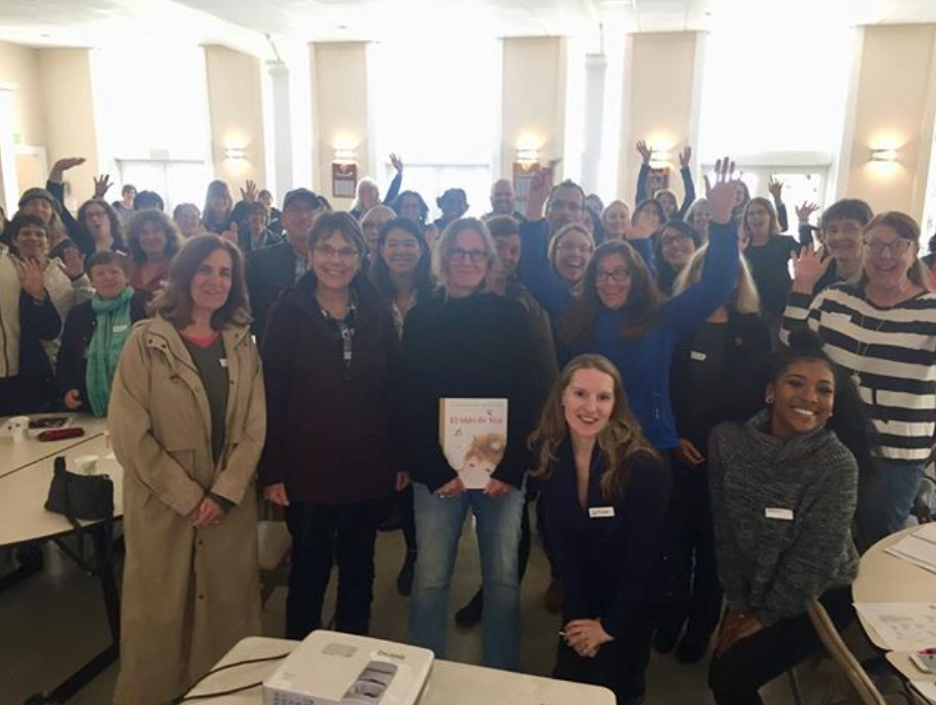
Plot Workshop
[JM] As writers much of what we put into our stories is a fictional version of our memories. Could you give us some tips for this process?
Of course! Another one I like. Personal memories are paramount when it comes to writing fiction. But using memories can snare you in the ‘truth trap, when you want to stay too close to how it actually happened. At times and in particularly when the memories are of the darker kind, using them can be a harrowing undertaking. I teach a master class Fictionalize Your Memories in which I let attendees play with points-of-view and tenses in a certain order. I designed writing exercises that allow you to keep the core emotion of a memory, while at the same time skillfully sidestepping the truth trap. This master class always, always results in beautiful stories brimming with wonder and surprise.
[JM] How Important has SCBWI been in your writing journey?
[MW] SCBWI was and is key in my writing journey. I would not be here, were it not for my SCBWI tribe. Because, yes, it is a tribe, a tribe of amazing, inspirational, knowledgeable, generous, fun, and professional people. These past years would have been the darkest if it hadn’t been for my SCBWI friends who tirelessly shone their guiding lights to make sure I continued my journey, who spurred me on not to give up, who caught me when I fell. The lifelong friendships that are forged through SCBWI are invaluable to me, as a writer and personally. I cannot thank Lin Oliver and Steve Mooser enough for starting this organization that is invaluable to so many creators of children’s books.
[JM] I have been fortunate to visit your lovely home in Berkeley, and see how it is a super inspirational place for a writer. The Bay Area is known to have a strong writing community, what have been your experiences with this over the last couple of years?
[MW] What can I say? It’s like a family. My first initiation in the Bay Area writing community was when my dear friend, former roommate, landlord and all-together amazing children’s book author and illustrator Jim Averbeck sent me to the library of the Mechanics’ Institute in San Francisco, where I was welcomed as if I were a long lost friend. Writers in these parts, from San Francisco to East Bay to Marin, are a tight-knit and supportive network. Are you in need of a critique group, an accountability group, a friend to join you to a bookish event? A simple shout-out is enough to find like-minded writers.
FIVE FUN ONES TO FINISH
[JM] What’s your favorite park (state/urban..) in the world?
[MW] Point Reyes National Seashore. The first time I visited Point Reyes, I sat down on a log washed ashore eons ago on the north beach. Staring out over the water, watching the cross currents swirl and sway, listening to the surf and the gulls, I felt more alive than ever before in my life. A truly magical place.
[JM] I have been several times to the Bay Area but have still to visit Point Reyes. It is on my bucket list. Cats or dogs? (or maybe parrots?)
[MW] Mooie Hond! My son’s knuffle dog who now resides with me in Berkeley.
[JM] Adorable! Please recommend a coffee shop or restaurant for me to visit in your city/town!
[MW] I like writing at the Musical Offering, a café/bistro/classical cd shop. They play classical music throughout the day and have free lunch concerts on Sundays and live jazz on Thursdays.
[JM] Great, I shall try this next time I am in Berkeley. What was your first paid job out of high school?
[MW] After I dropped out of Architecture School, my parents had me work in an uncle’s weaving mill. My job was folding towels. That is, until I got into trouble with the women who worked there day in, day out, year in, year out. They folded an average of 850 towels a day, but because I didn’t want to disappoint my uncle and knowing that I would get out in six weeks, I folded 1,000 towels a day. When the foreman upped their daily towel count, stating that if the temp could do it, they could too, they cornered me and ordered me to cut back. I can still hear my uncle’s bellowing laugh when I told him about my dilemma. He had me quickly transferred to another station, where I couldn’t do any harm.
[JM] Go to snack/drink to sustain your creative juices?
[MW] Tea! Always tea. Oolong. Earl Grey. Lapsang Souchong.
Thank you so much for sharing a bit of your writing life and craft with us, Mina. To your continued success!
https://minawitteman.com/

 Title: Grandma Gatewood Hikes the Appalachian Trail

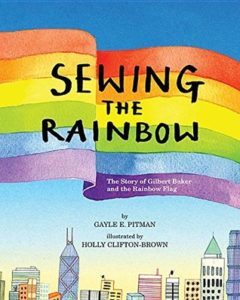 Title: Sewing the Rainbow – The Story of Gilbert Baker and the Rainbow Flag
 In my 20's, with only my guitar and a rucksack, I wandered the continents, immersing myself in the lives of some wonderful people, projects and stories, which changed the way I view my responsibility to others and this earth. Right now I'm a European transplant in the US who writes books for children and young adults. Stories can help us not only navigate our world but can connect us to others, and allow us to inspire and help each other. I believe that equity and empathy should be at the core of our all actions, words, and stories.
I am also a school librarian and I get a kick out of book-matchmaking! And I use the pronouns she/her.
In my 20's, with only my guitar and a rucksack, I wandered the continents, immersing myself in the lives of some wonderful people, projects and stories, which changed the way I view my responsibility to others and this earth. Right now I'm a European transplant in the US who writes books for children and young adults. Stories can help us not only navigate our world but can connect us to others, and allow us to inspire and help each other. I believe that equity and empathy should be at the core of our all actions, words, and stories.
I am also a school librarian and I get a kick out of book-matchmaking! And I use the pronouns she/her.